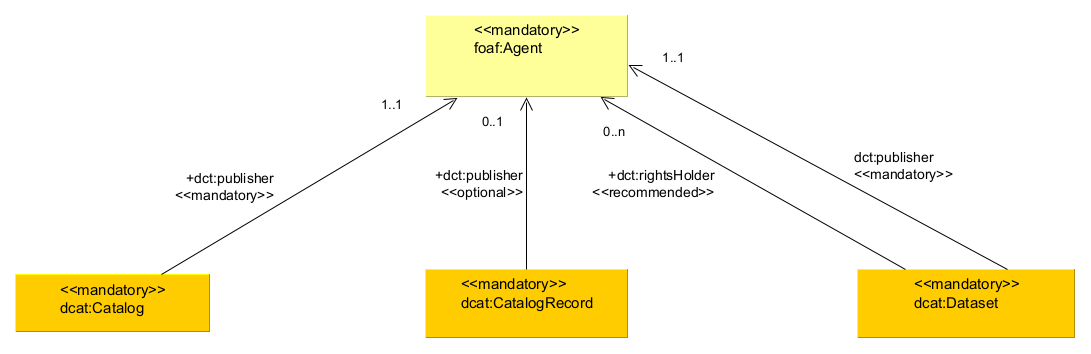

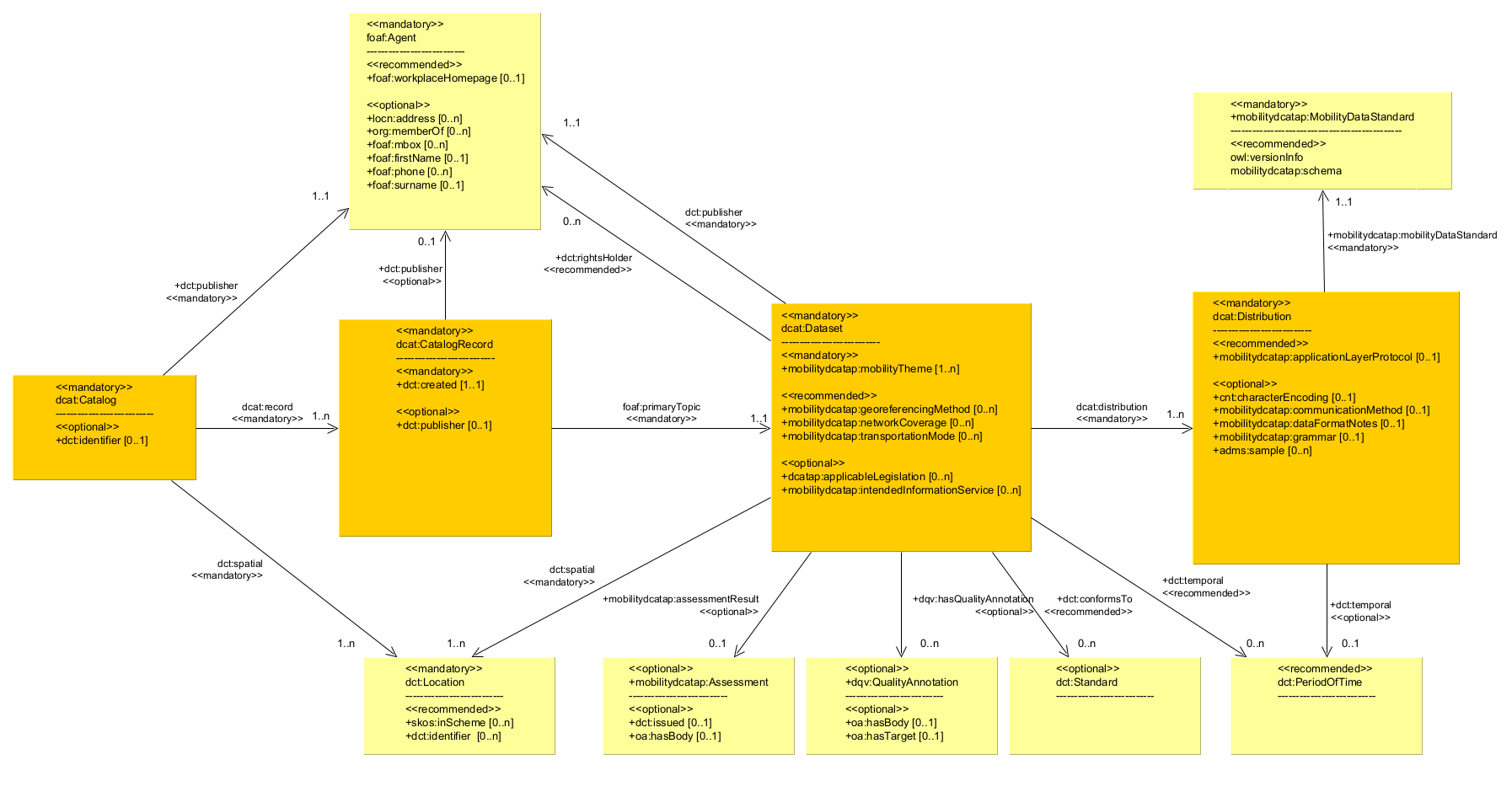
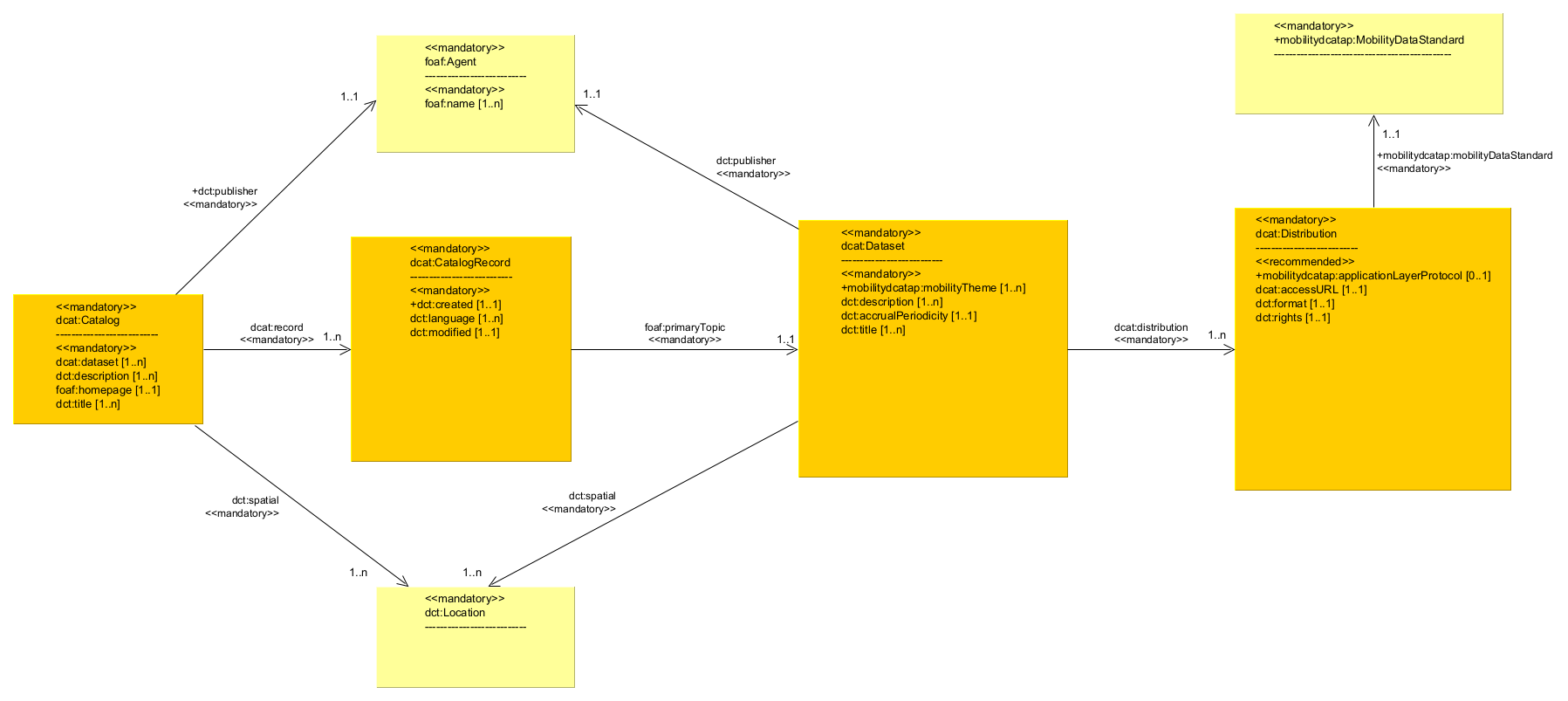
A quick reference table of properties per class is included in A. Quick Reference of Classes and Properties.
| Definition | An entity (e.g., an individual or an organisation) that is associated with Catalogues, Catalogue Records, or Datasets. |
|---|---|
| URI | |
| References | |
| Usage note |
If the agent is an organisation, the use of the Organization Ontology is recommended. See 11. Agent Types, Agent Roles and Contact Information for a discussion on Agent types, roles and properties. The agent might be populated with the same information as for a kind, see class When providing agent information, data publishers SHOULD prioritize organizational information over personal details. The exposure of personal information, such as a personal name and email address, may be restricted to the public. Instead, there might be an anonymous contact channel, e.g. a contact button on the GUI that triggers an email to the agent. See 13. Privacy and security considerations. |
| Properties |
For this entity the following properties are defined: address, affiliation, email, first name, name, phone, surname, type, URL. |
|
Property name and URI |
Range |
Card. |
Definition |
Usage note |
Reuse |
|---|---|---|---|---|---|
|
+address |
0..1 |
The postal address of the agent. |
This property is analogue to an addition by geoDCAT-AP v3.0.0. |
||
|
+affiliation |
0..1 |
The affiliation of the agent. |
This property is analogue to an addition by geoDCAT-AP v3.0.0. |
||
|
|
0..1 |
The email address of the agent, specified using fully qualified mailto: URI scheme RFC6068. |
This property is analogue to an addition by geoDCAT-AP v3.0.0. |
||
|
+first name |
0..1 |
The first name of the agent. |
To be used if the agent is of type person, see 11. Agent Types, Agent Roles and Contact Information. |
P |
|
|
name |
1..* |
A name of the agent. |
This property can be repeated for different versions of the name (e.g. the name in different languages) - see 12. Accessibility and Multilingual Aspects. |
||
|
+phone |
0..1 |
The phone number of the agent, specified using fully qualified tel: URI scheme RFC3966. |
This property is analogue to an addition by geoDCAT-AP v3.0.0. |
||
|
+surname |
0..1 |
The surname of the agent. |
To be used if the agent is of type person, see 11. Agent Types, Agent Roles and Contact Information. |
P |
|
|
type |
0..1 |
The nature of the agent. |
A controlled vocabulary is provided. |
||
|
+URL |
0..1 |
The Web site of the agent. |
This property is analogue to an addition by geoDCAT-AP v3.0.0. |
| Definition | An assessment procedure by an external organisation. This organisation may be a National Body in the context of EU Delegated Regulations. EU Delegated Regulations require Member States to set up procedures to assess the compliance with the applicable Delegated Regulations, e.g. regarding the provisioning of data via a NAP. These assessment processes are handled by National Bodies and installed individually in each Member State. |
|---|---|
| URI |
|
| References | DCAT: none |
| Usage note |
The information is optional and needed for the documentation of the assessment procedure. It may be an internal information, only visible for assessment organisations or other authorised users. |
| Properties |
For this entity the following properties are defined: assessment date, assessment result . |
|
Property name and URI |
Range |
Card. |
Definition |
Usage note |
Reuse |
|---|---|---|---|---|---|
|
+assessment date |
0..1 |
The date of the latest assessment procedure. |
A |
||
|
+assessment result |
0..1 |
The result of the latest assessment procedure, in form of a URL linking to further details or results. Alternatively, textual information is provided using the Embedded Textual Body construction of the Web Annotation Data Model, which allows to specify text formats and languages which might be relevant for multilingual purposes. |
A |
| Definition | A concrete mobility data portal, i.e, a web portal, where mobility-related datasets and their distributions are described via metadata and discoverable for data users. |
|---|---|
| URI | |
| References | |
| Usage note | |
| Properties |
For this entity the following properties are defined: dataset, description, geographical coverage, has part, homepage, identifier, language, licence, modification date, other identifier, publisher, crecord, release date, themes, title . |
|
Property name and URI |
Range |
Card. |
Definition |
Usage note |
Reuse |
|---|---|---|---|---|---|
|
dataset |
0..* |
Links the mobility data portal with a dataset that is described at the mobility data portal. |
This is a direct link from the mobility data portal to a dataset. However, in mobilityDCAT-AP, datasets should be linked indirectly, i.e., via the metadata record of this dataset.
Thus, it is mandatory to use the property |
||
|
description |
1..* |
A free-text account of the Catalogue. |
This property can be repeated for parallel language versions of the description - see 12. Accessibility and Multilingual Aspects. |
||
|
geographical coverage |
1..* |
A geographical area covered by the Catalogue. |
For National Access Points (NAPs), this corresponds to the EU Member State or a country that installs such NAP. The property might be used for analyses about available datasets per country, or to identify country-specific metadata in case metadata are federated from multiple national portals into an international portal.
It is not to be mixed up with country codes used within the dataset property The obligation of this property is raised to “mandatory”, comparing to DCAT-AP v3.0.0. |
||
|
has part |
0..* |
A related Catalogue that is part of the described Catalogue. |
This property could be used to link the mobility data portal to another data portal, by e.g. harvesting metadata from this other portal into the mobility data portal. |
||
|
homepage |
1..1 |
A web page that acts as the main page for the Catalogue. |
This property could be used to link the mobility data portal to another data portal, by e.g. harvesting metadata from this other portal into the mobility data portal. The obligation of this property is raised to “mandatory”, comparing to DCAT-AP v3.0.0. |
||
|
+identifier |
0..* |
The main identifier for the mobility data portal, e.g. the URI or other unique identifier. Allows a unique identification of the individual portal and is used for referencing, e.g., when exchanging metadata between mobility data portals. |
This property should populated by the URI used within the RDF statement (via This property is analogue to an addition by geoDCAT-AP v3.0.0. |
||
|
language |
0..* |
Language used in the user interface of the mobility data portal, in particular the textual metadata describing the datasets registered in the portal. |
This property can be repeated if the user interface and textual metadata are provided in multiple languages - see 12. Accessibility and Multilingual Aspects. |
||
|
licence |
0..1 |
A licence under which the Catalogue can be used or reused. |
|||
|
modification date |
0..1 |
The most recent date on which the Catalogue was modified. It is recommended to indicate modifications of the portal system as such (e.g., major technical updates of the portal or its features), rather than modifications of the hosted datasets, since datasets on mobility data portals are updaded frequently. |
|||
|
+other identifier |
0..1 |
This property may be used as an additional identifier, besides |
This property may be referring to a dedicated, EU-wide identificator system of NAPs or other portals, to be introduced in the future. This property is an addition by mobilityDCAT-AP. |
A |
|
|
publisher |
1..1 |
An entity (organisation) responsible for making the Catalogue available. This organisation is the direct contact for platform users, who have questions or issues about the platform and its system. |
This information should correspond to the information in the disclaimer of the platform website. |
||
|
record |
1..n |
A metadata record that is part of the mobility data portal. |
mobilityDCAT-AP assumes that metadata records are essential in mobility data portals, so the obligation of this property is raised to “mandatory”, comparing to DCAT-AP v3.0.0. |
||
|
release date |
0..1 |
The date of formal issuance (e.g., publication) of the mobility data portal. |
|||
|
themes |
0..* |
A knowledge organization system used to classify the mobility data portal's datasets. |
Recommended to indicate the version of the controlled vocabulary for property |
||
|
title |
1..* |
A name given to the mobility data portal. |
This property can be repeated for parallel language versions of the name - see 12. Accessibility and Multilingual Aspects. |
| Definition | A description of a metadata entry in the mobility data portal, referring to one dataset and its distributions published on the portal. |
|---|---|
| URI | |
| References | |
| Usage note |
mobilityDCAT-AP assumes that metadata records are essential in mobility data portals, so the obligation of this class is raised to “mandatory”, comparing to DCAT-AP-v3.0.0. |
| Properties |
For this entity the following properties are defined: language, listing date, modification date, primary topic, publisher, source metadata . |
|
Property name and URI |
Range |
Card. |
Definition |
Usage note |
Reuse |
|---|---|---|---|---|---|
|
language |
1..* |
The language used in the textual metadata describing titles, descriptions, etc. of the metadata entry. |
The value may be generated automatically by the NAP system, corresponding to the currently used language in the user interface. Some portals offer multilingual user interfaces, e.g., in the local language and additionally in English. For multiple languages - see 12. Accessibility and Multilingual Aspects. The obligation of this property is raised to “mandatory”, comparing to DCAT-AP v3.0.0. |
||
|
+listing date |
1..1 |
The date on which the metadata entry was included in the Catalogue. |
It should be generated by the system, whenever a platform user enters the metadata entry. |
||
|
modification date |
1..1 |
The most recent date on which the metadata entry was changed or modified. |
It should be generated by the system, whenever a platform user updates the metadata entry. If there has been no update yet, the value from the property |
||
|
primary topic |
1..1 |
Links the metadata entry to the dataset described in the entry. |
|||
|
+publisher |
0..1 |
An entity (an organisation or a person), which is responsible for creation and maintenance of the metadata entry on the data platform. This entity is the direct contact for the data platform operators or data-searching users, who have questions or issues about the metadata entry. |
This information can be natively created by a data platform, corresponding to the entity that is registered to the data platform and has the role of a metadata creator. This information can be also harvested from other portals.
The information might be identical to the property This property is analogue to an addition by GEODCAT-AP-v3.0.0. |
||
|
source metadata |
0..1 |
The original metadata record that was used in creating the metadata record. |
Used for metadata records that are harvested from other portals. Harvesting, i.e., the automated import of metadata information from external portals, seems to be a common case for some NAPs. With these property, a data user can see, if the metadata was harvested, and from where. The property should link to a public URL of the dataset descripton on the original data portal, from where the metadata was harvested. |
| Definition | A dataset is a collection of data, published or curated by a single source, and available for access or download at the mobility data portal in one or more distributions. In the context of mobility-related data exchange, this might be, e.g., a data collection about static parking information for truck drivers, published by a road authority. |
|---|---|
| URI | |
| References | |
| Usage note | |
| Properties |
For this entity the following properties are defined: applicable legislation, assessment result, geographical-coverage, contact point, dataset distribution, description, documentation, frequency, geographical coverage, georeferencing method, has version, identifier, in series, intended information service, is referenced by, keyword, language, mobility theme, modification date, network coverage, other identifier, publisher, quality description, reference system, related resource, release date, rights holder, source, temporal coverage, theme, title, transport mode, version, version notes, title . |
|
Property name and URI |
Range |
Card. |
Definition |
Usage note |
Reuse |
|---|---|---|---|---|---|
|
applicable legislation |
0..* |
A legal framework being relevant for the dataset, e.g., an EC Delegated Regulation which stipulates the provisioning of the corresponding dataset, or some other international or national frameworks, e.g., Open Data regulations. |
|||
|
+assessment result
|
0..1 |
The results and outcomes from an assessment process by an external organisation, e.g., a National Body in the context of EU Delegated Regulations. EU Delegated Regulations require Member States to set up procedures to assess the compliance of the Delegated Regulations, e.g. regarding the provisioning of data via a NAP. These assessment processes are handled by National Bodies and installed individually in each Member State. The property may point to the most recent assessment procedure, including its date, its result as a free-text and/or a link referring to an assessment report online. |
The difference to the property |
A |
|
|
contact point |
0..* |
Contact information that can be used for communication with a company or person responsible for the dataset. Used for questions or issues about a dataset and its provisioning, as raised by a platform user or a platform operator. |
When providing contact information, data publishers SHOULD prioritize organizational information over personal details. The exposure of personal information, such as a personal name and email address, may be restricted to the public. Instead, there might be an anonymous contact channel, e.g. a contact button on the GUI that triggers an email to the contact point. See 13. Privacy and security considerations. The contact point might be populated with the same information as for property |
||
|
dataset distribution |
1..* |
An available Distribution for the Dataset. |
In mobilityDCAT-AP, it is mandatory that each dataset has at least one distribution. Thus, the obligation of this property is raised to “mandatory”, compared to DCAT-AP v3.0.0. |
||
|
description |
1..* |
Information about the dataset as a free-text description. It is used only for a brief overview, because free-text fields are unsuitable for searches, due to spelling mistakes, different wordings and other aspects. The categorisation and other aspects about the dataset are described within other properties of the dataset. |
This property can be repeated for parallel language versions of the description - see 12. Accessibility and Multilingual Aspects.
The language version should correspond to property |
||
|
documentation |
0..* |
A page or document about this dataset. |
This property is meant to link to other ressources which document the dataset, e.g., PDF manuals, other websites or similar.
In contrast, the property Please note there is also the same property |
||
|
frequency |
1..1 |
Describes how often the delivered content is updated. This information tells a data consumer, how often it is updated on the on the data platform, so the data consumer might align the frequency of data retrieval accordingly. |
For dynamic data feeds, the frequency should correspond to the technical upload / data push frequency. For static datasets, it should correspond to the expected change frequency (see property A controlled vocabulary is provided. The obligation of this property is raised to “mandatory”, compared to DCAT-AP v3.0.0. |
||
|
geographical coverage |
1..n |
A geographic region that is covered by the delivered content. |
The obligation of this property is raised to “mandatory”, compared to DCAT-AP v3.0.0. |
||
|
+georeferencing method
|
0..n |
The georeferencing method used in the delivered content. |
A corresponding controlled vocabulary is provided, denoting commonly used georeferencing methods for mobility data. |
A |
|
|
has version |
0..n |
A related dataset that is a version, edition, or adaptation of the described dataset |
It might be used to host multiple versions of the same dataset in the data portal, also enabling a version history.
Multiple versions should be differentiated via the properties |
||
|
identifier |
0..1 |
The main identifier for the dataset, e.g. the URI or other unique identifier. Allows a unique identification of the individual dataset and is used for referencing, e.g., when exchanging metadata between mobility data portals. |
This property should populated by the URI used within the RDF statement (via |
||
|
in series |
0..* |
A dataset series of which the dataset is part. |
|||
|
+intended information service
|
0..n |
A type of information service, which the data content is intended to support. Such services may be, e.g., information services for multimodal mobility, as specified by EC Delegated Regulation 2024/490. Examples of such services include “location search”, which is based on a datasets with address identifiers, or “trip plan computation”, which is based on datasets on timetables. |
A corresponding controlled vocabulary is provided. |
A |
|
|
is referenced by |
0..* |
A related resource, such as a publication, that references, cites, or otherwise points to the dataset. |
It may be a link between two individual datasets that complement each other, e.g. one dataset with static parking data, and one with dynamic parking data, both covering the same parking facilities. |
||
|
keyword |
0..* |
A keyword or tag describing the Dataset. |
For the purposes of mobility data portals, it is not recommended to use keywords, as they might be ambiguous, language-dependend and make data search difficult. Instead, usage of mobility-related properties with Controlled Vocabularies is recommended, in particular If there are relevant keywords that are not part of such Controlled Vocabularies, please contact the authors of mobilityDCAT-AP, in order to update the Controlled Vocabularies. |
||
|
language |
0..* |
The language of the content data in a dataset, if this content has a natural language embedded, such as text fields, addresses etc. |
This property can be repeated if there are multiple languages in the dataset - see 12. Accessibility and Multilingual Aspects |
||
|
+mobility theme
|
1..n |
This property refers to the mobility-related theme (i.e., a specific subject, category, or type) of the delivered content. A dataset may be associated with multiple themes. A theme is important for data seekers who are interested in a particular type of data content. The theme is described via a controlled vocabulary in two hierarchy levels: The 1st level is a mandatory field labelled "Data content category", describing the classification of the data content on an aggregated level. The 2nd level is an optional field labelled “Data content sub category”, detailing the "Data content category" via one or several sub-categories. When entering the metadata for one dataset, the data provider would first select one or several options of a "Data content category", and then optionally details this with one or more options of corresponding “Data content sub category”. The platform must be able to handle the dependencies between these two levels, i.e., match the allowed options between the 1st and 2nd level. |
A corresponding controlled vocabulary is provided. This property is a sub-property of The subject of a dataset may also be described via property |
A |
|
|
modification date |
0..1 |
The most recent date on which the content of the dataset was changed or modified. |
This is redundant for high-frequency data feeds (e.g., DATEX II feeds), where the change date can be derived from the time stamp within the data feed. |
||
|
+network coverage
|
0..n |
This property describes the part of the transport network that is covered by the delivered content. For road traffic, the property should refer to the network classification for which the data is provided. As a minimum, an international or higher-level classification, e.g., via functional road classes, is recommended to allow data search across different countries. In addition, national classifications are allowed. For other transport modes, the property is meant to refer to the physical infrastructure which is used by the services covered by the data. For all modes, the property should also indicate if the data content relates to the EU’s trans-European transport network. |
A corresponding controlled vocabulary is provided, denoting commonly used road and infrastructure network classes. |
A |
|
|
other identifier |
0..* |
This property may be used as an additional identifier, besides |
This property may be referring to a dedicated, EU-wide identificator system of NAP datasets, to be introduced in the future, or other identificator systems such as DataCite, DOI, or W3ID. |
||
|
publisher |
1..1 |
An entity (company and person) that publishes the dataset. This entity is responsible for the provisioning of a dataset. The entity also concludes a contract, if applicable. |
This information can be natively created by a data platform, then corresponding to the entity that is registered to the data platform and has the role of a data publisher. The information might be identical to the property To establish a contact with a company or person responsible for the dataset, the property However, the publisher and the contact point might be populated with the same information. See 11. Agent Types, Agent Roles and Contact Information for further usage notes on that matter. The obligation of this property is raised to “mandatory”, comparing to DCAT-AP v3.0.0. |
||
|
+quality description |
0..n |
Any quality aspects regarding the delivered content, in particular methods, metrics/indicators and results of a quality assessment. This information should assist data consumers in determining the value of data, before actually accessing and processing it. Thus, the information should be publicly available. Furthermore, it can be helpful for validation processes by 3rd parties, e.g., a National Body in context of EU Delegated Regulations. |
Quality aspects should be noted via a free text and/or via URLs linking to further quality information. If there is absolutely no quality information, at least a note “quality information is unknown” should be given. If existing quality frameworks have been applied in the quality assessment, e.g., the Quality Frameworks from the NAPCORE project, these frameworks should be referenced. |
A |
|
|
+reference system |
0..n |
The spatial reference system used in the delivered content. To be specified via the “EPSG coordinate reference systems” register operated by OGC. |
A corresponding controlled vocabulary is provided. This is a sub-property of This property is analogue to an addition by geoDCAT-AP v3.0.0. |
||
|
related resource |
0..* |
A reference, citation, or otherwise pointing to another, related resource, such as another dataset. |
It may be a link between two individual datasets that complement each other, e.g. one dataset with static parking data, and one with dynamic parking data, both covering the same parking facilities. |
||
|
release date |
0..1 |
The date of formal issuance (e.g., publication) of the dataset. |
There might a difference to the creation date of the metadata entry, see the property |
||
|
+rights holder
|
0..n |
An entity that legally owns or holds the rights of the data provided in a dataset. This entity is legally responsible for the content of the data and (if applicable) for the relevance to legal frameworks (see property |
The rights holder will be in many cases identical with the publisher of the dataset (see property This property is analogue to an addition by geoDCAT-AP v3.0.0. |
||
|
source |
0..* |
A related Dataset from which the described Dataset is derived. |
There is the same property |
||
|
temporal coverage |
0..n |
A temporal period, i.e., the beginning and the end, of the time reference of the delivered content (e.g., validity time of a public-transport time table). |
|||
|
theme |
0..* |
The generic theme (i.e., a specific subject, category, or type) of the content of the dataset. |
A controlled vocabulary is provided. |
||
|
title |
1..* |
The name given to the dataset in a generic term. The name should be a meaningful, unique and unambiguous label. |
This property can be repeated for parallel language versions of the title - see 12. Accessibility and Multilingual Aspects.
The language version should correspond to property |
||
|
+transport mode
|
0..n |
The transport mode that is covered by the delivered content. |
A corresponding controlled vocabulary is provided, denoting commonly used transport modes. |
A |
|
|
version |
0..1 |
The version indicator (name or identifier) of a dataset. |
The version number should be updated, whenever there are changes to the dataset noted by the property Together with property The property URI has been replaced from |
||
|
version notes |
0..* |
A textual description of the differences between this version and a previous version of the dataset. |
This property should be an addition to the property
|
| Definition | A collection of datasets that are published separately, but share some characteristics that group them. |
|---|---|
| URI | |
| References | |
| Usage note | It is recommended to avoid Dataset Series without a dataset in the collection.
Therefore at least one Dataset should refer to a Dataset Series using the property in series ( Further instructions on the usage of Dataset Series are given in the mobilityDCAT-AP Wikisection on Dataset Series, the DCAT-AP Usage Guide on Dataset Series, and the DCAT-AP Examples for Dataset Series |
| Properties |
For this entity the following properties are defined: applicable legislation, contact point, description, frequency, geographical coverage, modification date, publisher, release date, temporal coverage, title . |
|
Property name and URI |
Range |
Card. |
Definition |
Usage note |
Reuse |
|---|---|---|---|---|---|
|
applicable legislation |
0..* |
A legal framework being relevant for the dataset series. |
|||
|
contact point |
0..* |
Contact information that can be used for communication with a company or person responsible for the dataset series. Used for questions or issues about a dataset series and its provisioning, as raised by a platform user or a platform operator. |
When providing contact information, data publishers SHOULD prioritize organizational information over personal details. The exposure of personal information, such as a personal name and email address, may be restricted to the public. Instead, there might be an anonymous contact channel, e.g. a contact button on the GUI that triggers an email to the contact point. See 13. Privacy and security considerations. |
||
|
description |
1..* |
Information about the dataset series as a free-text description. |
It is recommended to provide an indication about the dimensions the Dataset Series evolves, e.g., if the dataset seriesevolves according to the time, geolocation or other dimensions. This property can be repeated for parallel language versions of the description - see 12. Accessibility and Multilingual Aspects.
The language version should correspond to property |
||
|
frequency |
0..1 |
Describes how often the dataset series is updated. |
The frequency of a dataset series is understood differently to the frequency of the dataset in the collection, as declared via property |
||
|
geographical coverage |
0..* |
A geographic region that is covered by the dataset series. |
When spatial coverage is a dimension in the dataset series then the spatial coverage of each dataset in the collection should be part of the spatial coverage of the dataset series. In that case, the value of the spatial coverage of the dataset series should be as wide as possiblie. E.g., if datasets in a collection are about different regions in a country, the spatial coverage of the dataset series should note the entire country. See also the examples no. 7 and 8 in the Dataset Series examples section of DCAT-AP v3.0.0. |
||
|
+mobility theme
|
0..n |
This property refers to the mobility-related theme (i.e., a specific subject, category, or type) of the dataset series. A theme is important for data seekers who are interested in a particular type of data content. It is recommended that the theme does not change among datasets in the collection, i.e., the theme of the dataset series should be equal to the theme of each dataset in the collection. |
A corresponding controlled vocabulary is provided. |
P |
|
|
modification date |
0..1 |
The most recent date on which the dataset series was changed or modified. |
This should correspond to the most recent modification date of all datasets in the collection,
as declared via property |
||
|
publisher |
1..1 |
An entity (company and person) that publishes the dataset series. This entity is also responsible for ensuring the coherency of the dataset series. |
The publisher of the dataset series may or may be not the publisher of all datasets, as declared via property The obligation of this property is raised to “mandatory”, comparing to DCAT-AP v3.0.0. |
||
|
release date |
0..1 |
The date of formal issuance (e.g., publication) of the dataset series. |
The moment when the dataset series was established as a managed resource.
This might correspond to the earliest release date of the dataset in the collection, as declared via property |
||
|
temporal coverage |
0..n |
A temporal period, i.e., the beginning and the end, of the time reference that the Dataset Series covers. |
When temporal coverage is a dimension in the dataset series then the temporal coverage of each dataset in the collection should be part of the temporal coverage. In that case, an open ended value is recommended, e.g. "after 2012". |
||
|
title |
1..* |
The name given to the dataset series in a generic term. The name should be a meaningful, unique and unambiguous label. |
This property can be repeated for parallel language versions of the title - see 12. Accessibility and Multilingual Aspects. |
| Definition | A distribution describes the data formats and communication methods for a dataset. There may be one or multiple distributions for one dataset. For example, the same dataset (e.g. static parking information for truck drivers) can be provided in different ways e.g. as downloadable zip file or as XML using a REST web service. These are two distributions based on one dataset. |
|---|---|
| URI | |
| References | |
| Usage note |
For the context of mobility data portals, it can be expected that all datasets have one or more distributions. Thus, there must be at least one instance of class Distribution related to one dataset. This is in contrast to DCAT-AP v3.0.0, which allows for datasets without distributions. |
| Properties |
For this entity the following properties are defined: access url, application layer protocol, applicable legislation, character encoding, communication method, data format notes, description, documentation, download url, format, language, licence, linked schemas, mobility data standard, modification date, release date, rights, sample, status, temporal coverage, title. |
|
Property name and URI |
Range |
Card. |
Definition |
Usage note |
Reuse |
|---|---|---|---|---|---|
|
access url |
1..1 |
A URL that gives access to a distribution of the dataset. |
Depending on the type of data provision, there are different options for describing the URL. For data services, e.g., API, broker services, data feeds, etc., the URL may be the end point of such service. If some agreements between the data provider and the data user need to be established first, the access URL may link to web page, where the access is further arranged, e.g., initiating a a subscription process. For data which can be downloaded directly, the download URL should be copied from the property For other cases, where data cannot be directly accessed or downloaded via the platform, the access URL may be a link to an external service or a website which enables access to the data. |
||
|
+application layer protocol
|
0..1 |
The transmitting channel, i.e., the Application Layer Protocol, of the distribution. |
A corresponding controlled vocabulary is provided. |
P |
|
|
applicable legislation |
0..* |
A legal framework being relevant for the distribution. |
The legal framework is usually provided on the dataset level, see property |
||
|
+character encoding
|
0..1 |
The technical encoding format of the delivered content within the distribution. |
It SHOULD be expressed using a character set name defined in the IANA character sets register. This property is analogue to an addition by geoDCAT-AP v3.0.0. |
||
|
+communication method
|
0..1 |
Indicates for dynamically provided distributions, e.g., data feeds, if the data interface of the data provider system functions in a push or pull mode. |
A corresponding controlled vocabulary is provided. |
P |
|
|
+data format notes
|
0..* |
Any additional information about the format of the delivered content within the distribution in a textual format. |
This property can be repeated for parallel language versions of the data format notes - see 12. Accessibility and Multilingual Aspects. |
P |
|
|
description |
0..* |
A free-text account of the Distribution. |
This property can be repeated for parallel language versions of the description - see 12. Accessibility and Multilingual Aspects. |
||
|
documentation |
0..* |
A page or document about the distribution. |
This property is meant to link to other ressources which document the data distribution, e.g., PDF manuals, other websites or similar.
In contrast, the property Please note there is also the same property |
||
|
download url |
0..1 |
A URL that is a direct link to a downloadable file in a given format. |
|||
|
format |
1..1 |
The technical syntax of the delivered content within the distribution. It describes the base standard that specifies syntactically correct documents. On this level, base elements are properly specified on how to build a document. The resulting document can then be validated by syntax checks. |
A controlled vocabulary is provided. The obligation of this property is raised to “mandatory”, compared to DCAT-AP v3.0.0. There is a similar property in DCAT-AP v3.0.0 called |
||
|
language |
0..* |
The language of the content data in a distribution, if this content has a natural language embedded, such as text fields, addresses etc. |
There is the same property This property can be repeated if there are multiple languages in the distribution - see 12. Accessibility and Multilingual Aspects |
||
|
licence |
0..1 |
The licence under which the distribution is made available. This should be a reference to a concrete (standard) licence. |
A controlled vocabulary is provided. |
||
|
linked schemas |
0..* |
An established schema to which the described Distribution conforms. |
To inform about a mobility data standard (and also related profiles) applied to the delivered data,
property |
||
|
+mobility data standard
|
1..* |
The mobility data standard, as applied for the delivered content within the distribution. A mobility data standard, e.g., DATEX II, combines syntax and semantic definitions of entities in a certain domain (e.g., for DATEX II: road traffic information), and optionally adds technical rules for data exchange. This is a sub-property of |
A corresponding controlled vocabulary is provided, listing common mobility data standards. At least one value from this controlled vocabulary is required. If no suitable standard is found in this vocabulary, the "other" entry should be used. Optionally, a new individual instance of class |
P |
|
|
modification date |
0..1 |
The most recent date on which the Distribution was changed or modified. |
There is the same property |
||
|
release date |
0..1 |
The date of formal issuance (e.g., publication) of the Distribution. |
There is the same property |
||
|
rights |
1..1 |
A statement that specifies rights associated with the distribution. In particular, a statement about the intellectual property rights (IPR). As a minimum, it should include an information on the type of conditions for access and usage. |
A concrete (standard) license can be referred via the recommended property The obligation of this property is raised to “mandatory”, compared to DCAT-AP v3.0.0. |
||
|
+sample |
0..* |
A sample of the delivered content, using the same conditions (e.g., the same format and licence) as the regular disctribution. A sample allows data users to investigate the data content and data structure, without subscribing to a data feed or downloading a complete data set. |
In DCAT-AP v3.0.0,
there is a property |
P |
|
|
status |
0..1 |
The status of the distribution in the context of maturity lifecycle. |
It must take one of the values Completed, Deprecated, Under Development, Withdrawn. A corresponding controlled vocabulary is provided. |
||
|
+temporal coverage |
0..1 |
The time interval when a distribution is facilitated (i.e., activated) technically via the data platform. Might be used if data access via a distribution is limited in time. |
If there is no entry it means that the distribution has no explicit start time (i.e., it is facilitated immediately) and has no end time (i.e., it is facilitated infinitely). |
P |
|
|
title |
0..* |
A name given to the distribution. |
This property can be repeated for parallel language versions of the title - see 12. Accessibility and Multilingual Aspects. |
| Definition | A description following the VCARD-RDF specification, e.g., to provide telephone number and e-mail address for a contact point. |
|---|---|
| URI | |
| References | |
| Usage note |
This class is the parent class for the four explicit types of vCards ( The contact point might be populated with the same information as for an agent, see class When providing contact information, data publishers SHOULD prioritize organizational information over personal details. The exposure of personal information, such as a personal name and email address, may be restricted to the public. Instead, there might be an anonymous contact channel, e.g. a contact button on the GUI that triggers an email to the agent. See 13. Privacy and security considerations. |
| Properties |
For this entity the following properties are defined: address, affiliation, email, name, phone, URL . |
|
Property name and URI |
Range |
Card. |
Definition |
Usage note |
Reuse |
|---|---|---|---|---|---|
|
+address |
0..1 |
The postal address of the kind, i.e., of an individual, an organization, a location or a group. |
This property is analogue to an addition by geoDCAT-AP v3.0.0. |
||
|
+affiliation |
0..1 |
The affiliation of the kind, i.e., of an individual, an organization, a location or a group. |
This property is analogue to an addition by geoDCAT-AP v3.0.0. |
||
|
|
1..1 |
The email address of the kind (i.e., an individual, an organization, a location or a group), specified using fully qualified mailto: URI scheme RFC6068. |
This property is analogue to an addition by geoDCAT-AP v3.0.0, however, with an raised obligation level. |
||
|
+name |
1..1 |
A name of the kind, i.e., a unique name of an individual, an organization, a location or a group. |
This property is analogue to an addition by geoDCAT-AP v3.0.0, however, with an raised obligation level. |
||
|
+phone |
0..1 |
The phone number of the kind (i.e., an individual, an organization, a location or a group), specified using fully qualified tel: URI scheme RFC3966. |
This property is analogue to an addition by geoDCAT-AP v3.0.0. |
||
|
+URL |
0..1 |
A web site of the kind., i.e., of an individual, an organization, a location or a group. |
This property is analogue to an addition by geoDCAT-AP v3.0.0. |
| Definition | A legal document, e.g., a concrete license, giving official permission to do something with a resource. |
|---|---|
| URI | |
| References | |
| Usage note |
This property is used to reference an applicable (standard) licence via an IRI, so a data user can assess the license conditions in machine- and human-readable formats, before using the data. Via an instance of this class, a reference to a standard or a organisation-specific license can be given. For standard licenses, a Controlled Vocabulary is provided. See the Wiki page on Rights and Licenses for further guidance. |
| Properties |
This specification does not impose any additional requirements to properties for this entity. |
| Definition | A spatial region or named place. |
|---|---|
| URI | |
| References | |
| Usage note |
It can be represented via a named place (controlled vocabulary) or with geographic coordinates, according to DCAT-AP guidelines. For mobility data portals, usage of a named place is preferred. Many mobility data providers represent public authorities such as states, regions, municipalities etc, which can be easily represented via named places. In contrast, defining of coordinates per dataset might be error-prone and inconsistent. As named spaces, identifiers should be used via property |
| Properties |
For this entity the following properties are defined: bounding box, centroid, gazetteer, geographic identifier, geographic name, geometry . |
|
Property name and URI |
Range |
Card. |
Definition |
Usage note |
Reuse |
|---|---|---|---|---|---|
|
bounding box |
0..1 |
The geographic bounding box of the location. |
|||
|
centroid |
0..1 |
The geographic center (centroid) of the location. |
|||
|
+gazetteer |
0..1 |
The gazetteer, i.e., a codelist to which the location belongs. |
This property is analogue to an addition by geoDCAT-AP v3.0.0. |
||
|
+geographic identifier |
0..* |
This property contains the geographic identifier for the location, e.g., the URI or other unique identifier in the context of the relevant gazetteer. |
Corresponding controlled vocabularies are provided, denoting commonly used geographic identifiers. This property is analogue to an addition by geoDCAT-AP v3.0.0. |
||
|
+geographic name |
0..* |
A preferred label of the location. |
This property can be repeated for parallel language versions of the label - see 12. Accessibility and Multilingual Aspects. This property is analogue to an addition by geoDCAT-AP v3.0.0. |
||
|
geometry |
0..1 |
The corresponding geometry for the location. |
Cannot GET /src/tables/class-mobility-data-standard|
Property name and URI |
Range |
Card. |
Definition |
Usage note |
Reuse |
|---|---|---|---|---|---|
|
+specific content model
|
0..1 |
The specific content model of applied mobility data standard. |
A corresponding controlled vocabulary is provided. Content models of mobility data standards can cover wide range of applications so the information about used standard is rather broad information. These standards already have more specific content models, which provide much more specific information about what content can be expected. In case of DATEX II there are content models like SituationPublication, ParkingTablePublication, ParkingStatusPublication etc. |
P |
|
|
+conforms to |
0..* |
Reference to the applied mobility data standard, as well as to individual/national/content-specific profiles or representations of the applied standard. |
This property is necessary if a custom instance of class |
P |
|
|
+title |
0..* |
A name given to the mobility data standard. |
This property can be repeated for parallel language versions of the title - see 12. Accessibility and Multilingual Aspects. |
P |
|
|
+version |
0..1 |
The version of the mobility data standard, as applied within the delivered content. A version might be, e.g., DATEX II v3.2. |
This information is provided in a textual format. To avoid ambiguity, only short version identifiers should be used, e.g., "3.2", without redundant acronyms such as "v", underscores etc. |
P |
| Definition | An annotation about any quality aspects regarding the delivered content, in particular methods, metrics/indicators and results of a quality assessment in the responsibility of the Data Owner. |
|---|---|
| URI | |
| References | DCAT: none |
| Usage note |
There is a similar class Quality Measurement" in geoDCAT-AP v3.0.0. Both "Quality Annotation" are "Quality Measurement" are reusing the Data Quality Vocabulary. "Quality Measurement is referring to concrete metrics, like sub-types of spatial resolutions being used in GeoDCAT-AP. At mobility data portals, however, the practice so far is to provide a more generic quality description, e.g., via a free-text report. Thus, the "Quality Annotation" refers to an unspecified form of quality annotation. |
| Properties |
For this entity the following properties are defined: quality annotation resource, quality annotation target . |
|
Property name and URI |
Range |
Card. |
Definition |
Usage note |
Reuse |
|---|---|---|---|---|---|
|
+quality annotation resource |
0..1 |
Any quality aspects regarding the delivered content, in form of a URL linking to further details or results, or textual information. |
Textual information should be provided using the Embedded Textual Body construction of the Web Annotation Data Model, which allows to specify text formats and languages which might be relevant for multilingual purposes. |
A |
|
|
+quality annotation target |
0..1 |
the target of the quality annotation, referring back to the dataset being described. |
It is the inverse property of |
A |